
AI SEO Authority is the combination of signals that make a brand more likely to be retrieved, trusted, and cited in AI-generated answers.
In simple terms, it explains why some brands keep showing up in AI answers while others barely appear at all.

These signals include how easily a page can be discovered by search systems, how clearly its content can be extracted into answers, and how credible the brand appears across the wider web.
As AI search tools such as Google AI Overviews, ChatGPT, Perplexity, and Gemini become a normal part of search behaviour, visibility is no longer only about ranking webpages.
Increasingly, brands need to appear inside the answers themselves.
That is where AI Authority becomes important.
Why AI SEO Authority Matters
Search behaviour is already shifting toward AI-generated responses.
AI-driven discovery is no longer emerging. It is already happening at scale.
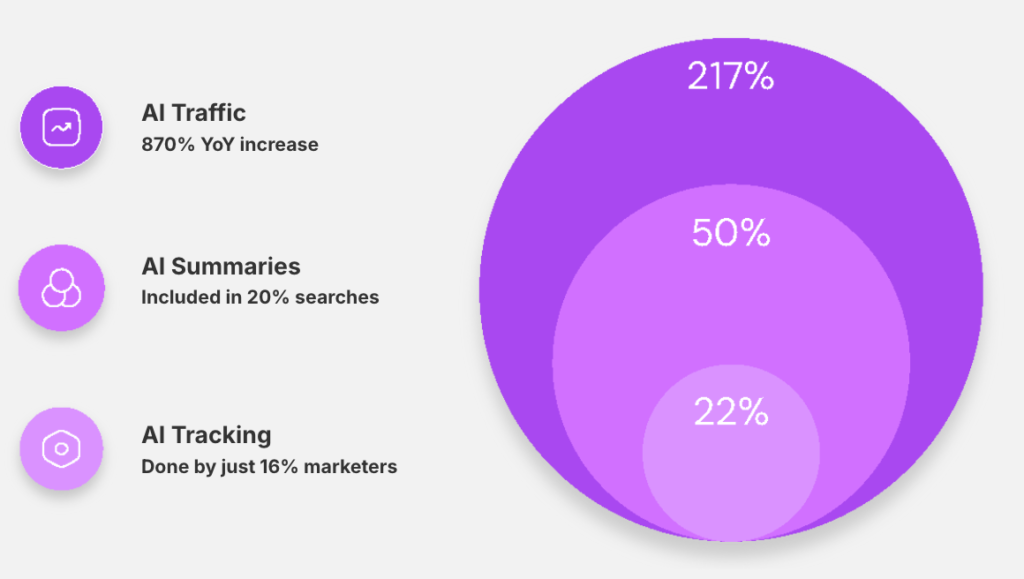
- AI referral traffic has increased by around 870 percent year on year
- AI Overviews now appear in roughly 20 percent of Google searches
- Yet only 16 percent of brands actively track AI visibility
At the same time, research from Bain & Company shows that around 80 percent of users rely on AI-generated summaries for at least 40 percent of their searches.
Bain also estimates this shift could reduce traditional organic web traffic by 15 to 25 percent.
People are reading the answer, not the list of links.
That changes what visibility means.
Instead of competing only for rankings in search results, brands increasingly need to compete to become one of the sources AI systems choose to reference.
Which sources get chosen depends heavily on the type of question being asked.
How Query Fan-Out Shapes AI Answers
AI systems do not rely on a single query.
They expand it.
This process is often referred to as query fan-out.
Instead of answering a question directly from one search, AI systems generate multiple related queries behind the scenes.
For example, a prompt like:
“What are the best email marketing tools for small businesses?”
may trigger additional queries such as:
- best email marketing software comparison
- top tools for small business email campaigns
- email marketing platforms pricing and features
- expert reviews of email marketing tools
The AI system then retrieves information across this expanded set of queries and combines it into a single answer.
This is important because it changes how visibility works.
You are not competing for a single query.
You are competing across a cluster of related queries that contribute to the final answer.
How AI Systems Decide What to Cite
AI systems do not create answers out of thin air.
They retrieve information from the web and summarise it into responses.
In most cases, this process begins with traditional search retrieval systems.
If a page cannot be retrieved during this stage, the AI system never reads it.
AI cannot cite what it never retrieves.
From there, the AI analyses retrieved pages and selects passages that are relevant to the question, clearly written, factual, and associated with credible sources.
The sources themselves also matter.
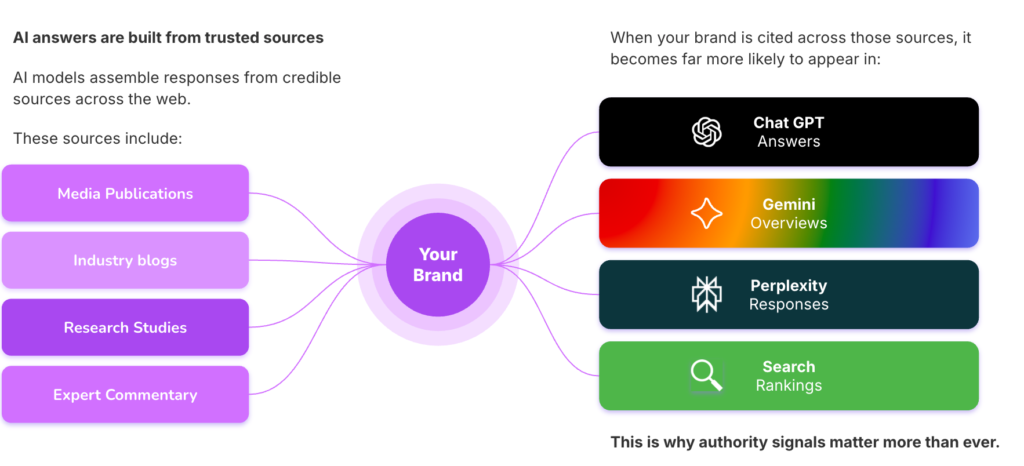
AI systems commonly draw from:
- media publications
- industry blogs
- research studies
- expert commentary
Google has said that that the same foundational SEO best practices still apply to AI search features.
In simple terms, AI systems tend to surface information that is easy to retrieve and easy to trust.
Example: How AI SEO Authority Influences Visibility
Imagine two ecommerce brands selling the same product category.
Brand A publishes detailed buying guides and product explanations. It is cited in several industry publications. It appears in expert roundups and comparison articles.
Brand B only publishes product pages. It has very few external mentions. It provides limited informational content.

When an AI system generates an answer about that product category, Brand A is far more likely to be referenced.
That does not necessarily mean Brand A ranks first in search results.
Instead, it means the brand sends stronger signals of credibility and expertise.
The Four Core Signals of AI SEO Authority
AI SEO Authority is not determined by a single ranking factor.
It develops through multiple observable signals that help search systems understand and trust a source.
Four broad signals tend to contribute to AI Authority.
1. Retrievability
Pages must be discoverable through search systems.
If a page cannot be retrieved, it cannot be cited.
Clear titles, headings, internal links, and structured content all support this.
2. Extractable Content
AI systems favour information that can be easily quoted or summarised.
Content that includes clear explanations, definitions, structured sections, and direct answers is much easier to extract into AI responses.
3. Entity Recognition
AI systems increasingly rely on entities to understand organisations and brands.
When a company appears consistently across websites, profiles, and publications, it becomes easier for search systems to understand what that entity represents.

4. Authority Signals
External validation plays a major role.
This includes citations in credible publications, mentions across trusted sources, authoritative backlinks, and brand presence across influence networks.
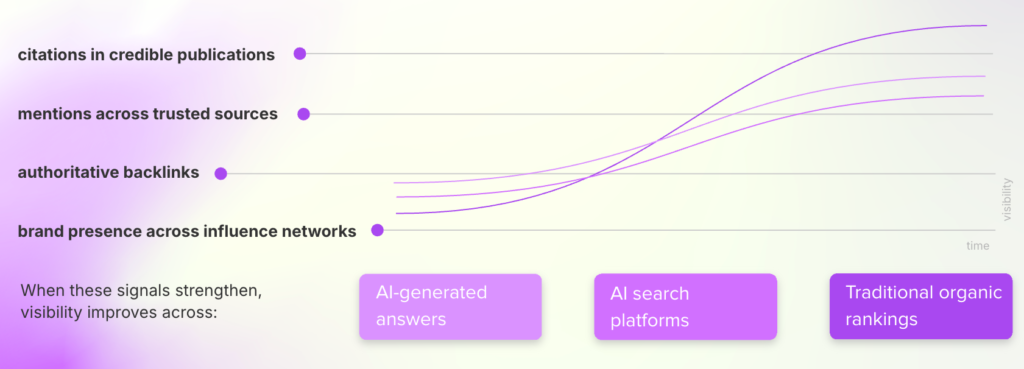
These signals do not work in isolation.
They reinforce each other.
A page that is easy to retrieve but lacks credibility is unlikely to be cited.
A well-known brand with no clear, extractable content is harder for AI systems to use.
AI SEO Authority emerges when these signals align.
That is when a brand becomes consistently visible across both search results and AI-generated answers.
This is also why authority behaves differently from traditional performance channels.
Authority Compounds. Paid Does Not.
Paid acquisition creates visibility, but it does not build lasting presence.
When spend stops, traffic stops.
Authority works differently.
Citations stay live.
Backlinks continue strengthening rankings.
Brand mentions build recognition over time.
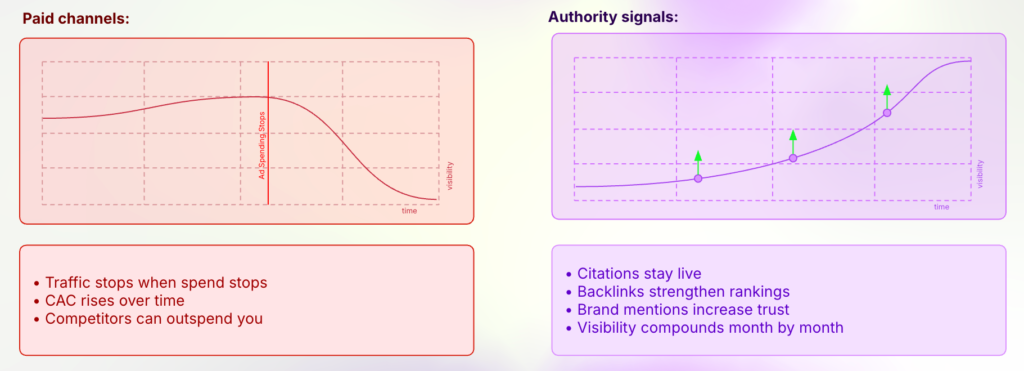
Paid channels rent attention.
Authority compounds.
Visibility compounds.
That is why brands investing in authority signals early gain a structural advantage.
AI SEO Authority Is Not Just a Content Problem
A common mistake is that AI visibility can be solved purely through better content writing.
That would be convenient. But unfortunately it isn’t true.

In reality, appearing in AI answers depends on multiple combined signals.
Strong informational content helps explain the topic.
Mentions in credible publications reinforce expertise.
Consistent brand references across the web strengthen recognition.
The gap is not just content quality. It is authority.
AI SEO Authority Is Prompt-Dependent
AI visibility is not fixed.
It changes depending on the query.
Different prompts surface different sources.
For example:
- A “best tools” query may prioritise comparison articles and affiliate reviews
- A “what is” query may favour educational guides and definitions
- A “which is better” query may surface editorial content and expert opinions
That means there is no single list of authoritative websites that always get cited.
The sources that influence AI answers depend on the intent behind the prompt.
The strategic advantage comes from understanding this.
Instead of trying to build authority everywhere, the goal is to identify:
- which prompts matter in your category
- which sources are consistently cited for those prompts
Then position your brand within those sources.
In other words, AI SEO Authority is not just about being mentioned across the web.
It is about being visible in the specific places AI systems rely on for your category and use cases.
How Brands Can Start Building AI SEO Authority
Most successful brands focus on three practical areas.
Publish helpful informational content
- Content that clearly answers questions is easier for AI systems to extract.
- Buying guides, explainers, and educational resources often perform well.
Build recognition across trusted sources
- Mentions in credible publications, industry blogs, and research-driven content help reinforce authority.
- These references signal that your brand is recognised beyond its own website.
Strengthen brand clarity
- Clear company descriptions, consistent messaging, and recognisable profiles across platforms help search systems understand your brand as a defined entity.
- Over time, these signals combine to strengthen AI Authority.
The Shift From Ranking to Being Referenced
Traditional SEO focused on ranking webpages.
AI search introduces another layer. Being referenced inside answers.
This does not replace SEO. It expands it.
Instead of asking only how to rank higher, brands increasingly need to ask why an AI system would choose to cite them.
Key Takeaway
AI SEO Authority is not just about publishing content.
It emerges from the combination of:
- retrievability
- extractable information
- recognised expertise across the web
Brands that demonstrate these signals are far more likely to appear in AI-generated answers as search continues to evolve.
If you want to understand how your brand actually shows up in AI answers, the next step is to look at what is influencing them.
Our AI Authority System is designed to build the authority signals AI platforms and search engines trust.
Frequently Asked Questions
What does AI SEO Authority mean?
AI SEO Authority refers to how likely a brand or website is to be retrieved, trusted, and cited when AI systems generate answers to search queries.
Why is AI SEO Authority important?
It determines whether your content appears inside AI-generated answers across platforms such as ChatGPT, Google AI Overviews, and other AI search tools.
Can smaller brands build AI SEO Authority?
Yes. Smaller brands can build authority by publishing helpful content, earning trusted mentions, and establishing clear expertise in a specific niche.
Does AI Authority replace SEO?
No. Traditional SEO fundamentals still matter because AI systems rely on search retrieval to discover relevant pages.