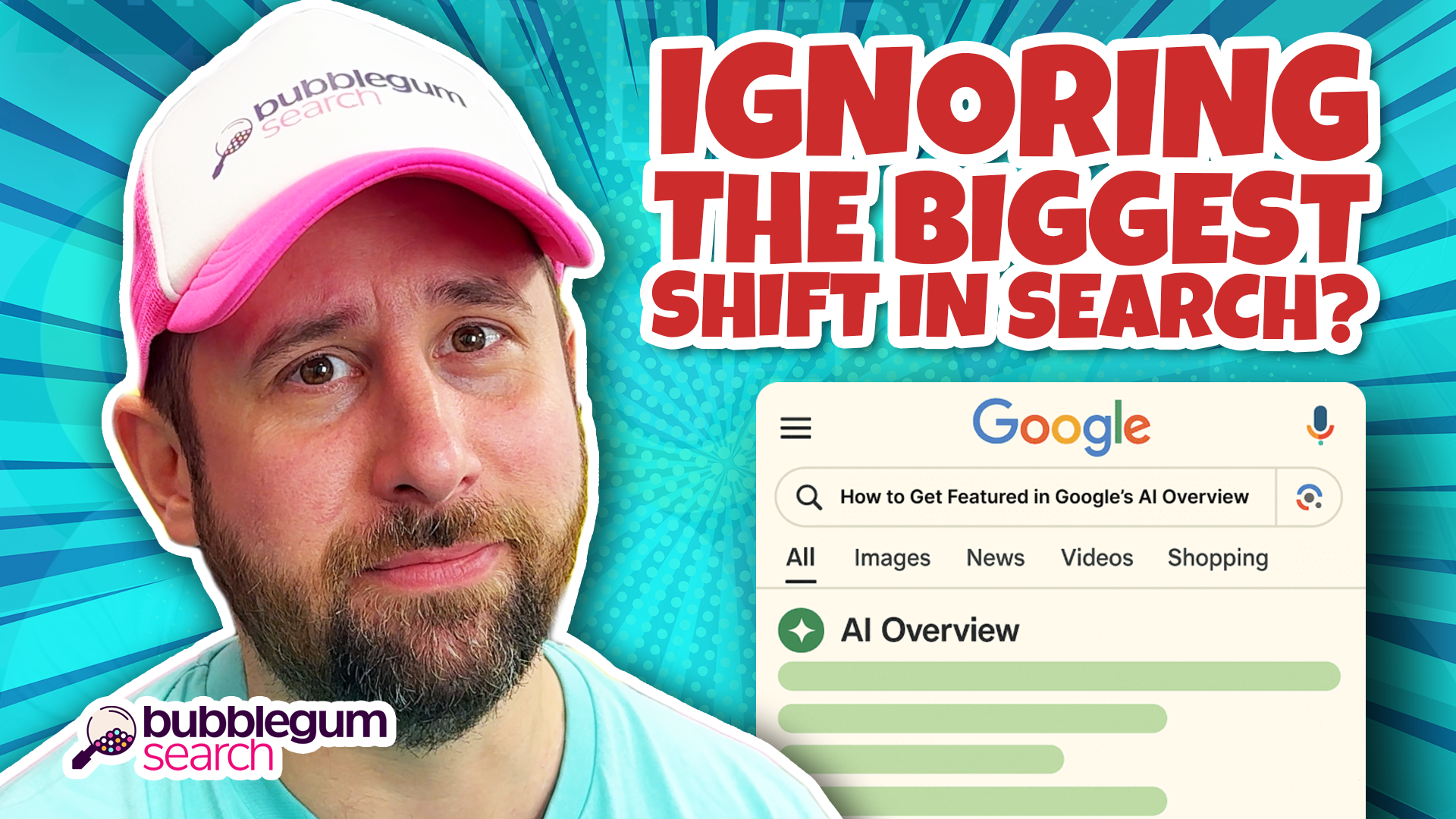

Watch on YouTube and use the comments for any questions – I reply to every one!
If your SEO agency is not talking to you about AI search, that is not a red flag.
That is the smoke alarm going off at two in the morning.
Right now, the biggest visibility shift in years is happening in plain sight.
And some agencies are still sharing ranking screenshots like they have just discovered fire.
AI Overviews answer the question.
AI Mode continues the conversation.
ChatGPT shortcuts the research and recommends what to do next.
And in many cases, the user never clicks anything.
If your entire plan is still focused only on organic rankings, you are leaving a lot of opportunity on the table.
Rankings still matter.
They are just no longer the whole picture.
You now need to show up in the answer.
1. AI search is not a new discipline
Let’s clear this up early.
AI SEO.
AEO.
GEO.
Whatever acronym the internet is arguing about this week.
It is still SEO.

The fundamentals have not disappeared.
They have been reweighted.
You are no longer just trying to rank pages.
You are trying to be mentioned.
Referenced.
Recommended.
Inside AI Overviews.
Inside AI Mode.
Inside conversational answers where the click never happens.
If your agency is acting like rankings are the only thing that matters, they are optimising for a version of search that no longer exists.
2. AI Overviews and AI Mode are not the same thing
This part gets confused a lot.
AI Overviews summarise answers directly in search results.
AI Mode turns search into a conversation.
Follow ups.
Comparisons.
Reasoning.
They pull from similar signals.
They both reduce clicks.
They both reward brands that are mentioned, not just ranked.
You can rank number one.
And still not exist in either.
That is the new reality.
3. The data behind AI visibility
This is not guesswork.
Correlation studies from platforms like Ahrefs show clear patterns across AI Overviews, AI Mode and ChatGPT.
Quick disclaimer so nobody panics.

Correlation is not causation.
But when the signal is consistent and loud, it becomes a useful directional guide.
Here is what the data shows.
Brand mentions on platforms like YouTube sit at the top of the correlation factors.
Branded web mentions follow closely behind.
Traditional metrics like domain ratings and raw link counts fall much lower.
Paid ads barely register.
In simple terms, brand signals beat metrics.
AI visibility cannot be forced with a few extra links.
It is driven by broader signals of trust and relevance.
4. This is not just Google favouring YouTube
Here is where it gets interesting.
ChatGPT shows almost identical correlation patterns.
And YouTube is one of its most cited domains overall.
This is not a Google specific bias.
It is cross model behaviour.
If your brand never appears on YouTube, no owned content, no guest appearances, no mentions, you are effectively invisible in these systems.
You are whispering expertise while everyone else is holding a microphone.
5. Where AI systems actually learn
AI does not learn only from websites.
It learns from repetition and consensus across the web.
Wikipedia.
Reddit.
Forums.
Communities.
Long form discussions.
Repeated mentions in trusted environments.
These systems are confidence engines.
They look for proof that a brand exists beyond its own homepage.
If your only footprint is your own site, you are asking AI to trust you on faith alone.
That rarely works.
6. Same SEO tools, different weighting
This is the part many agencies miss.
SEO is not dead.
Technical SEO still matters.
Content still matters.
Links still matter.
What has changed is weighting.
Brand signals.
Mentions.
Demand.
Distribution.
These often matter more than raw link metrics on their own.
The tools are the same.
The priorities are not.
If the conversation never moves beyond audits, on page tweaks and backlinks, your visibility strategy is incomplete.
7. What good measurement looks like now
Tracking rankings alone is no longer enough.
You need to measure brand presence.
Branded web mentions over time.
Branded search demand trends.
YouTube appearances and mentions.
Citations inside AI answers.
You also need to understand what happens after AI exposure.
Using analytics platforms to track AI referred traffic.
Conversions.
Landing pages.
Then watching how that performance evolves month to month.
That is how you measure AI search properly.
The takeaway
AI search visibility is not a brand new discipline.
It is SEO with brand and distribution turned up.
If you want lower acquisition costs, less dependency on paid media and long term demand, you need PR, brand signals and ideally a YouTube strategy in the mix.
If your SEO agency is not talking to you about any of this, they are not just behind the curve.
They are playing the wrong game.
If you want AI SEO that is transparent, focused and built to deliver results, that is exactly what we do at Bubblegum Search.
Watch on YouTube and use the comments for any questions – I reply to every one!