
AI referrals are still a small slice of traffic for most sites. But across a set of websites we manage, measurable AI referral sessions (ChatGPT, Perplexity, Gemini, Claude, and others) are often converting at a higher rate than organic search sessions.
This analysis was conducted by Bubblegum Search, using GA4 data from a mix of service and ecommerce brands.
“AI traffic is not big yet for most sites, but it’s already showing signs of being disproportionately valuable when it lands on the right pages.”
Matt Cayless, Founder, Bubblegum Search
Methodology
We analysed GA4 data across 15 sites (a mix of UK and US brands) over the 2025 calendar year, comparing measurable AI referral sessions against organic search sessions over the same period. A “conversion” here means each site’s preferred key event (agreed with the client). We also reviewed top 25 landing pages for AI traffic vs organic search for these sites to understand entry-page patterns.
Note: “Measurable AI referrals” refers to sessions where GA4 shows an identifiable AI referrer (for example chatgpt.com, perplexity.ai, claude.ai, gemini.google.com, copilot.microsoft.com). It does not capture AI-influenced visits that arrive as “direct” or are otherwise untagged.
The headline findings
1) AI referrals are small, but not meaningless
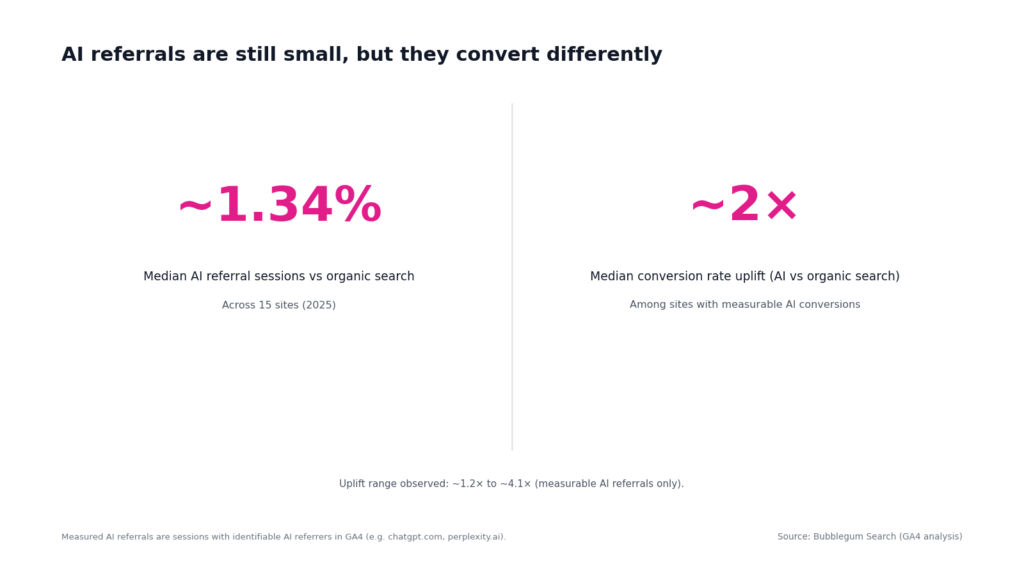
Across the accounts reviewed, AI traffic typically sits at around ~1 to 2% of organic search session volume (median ~1.34%). In plain English: you might not notice it in a topline channel chart yet, but it’s already large enough to influence leads and sales on some sites.
2) When AI converts, it converts better
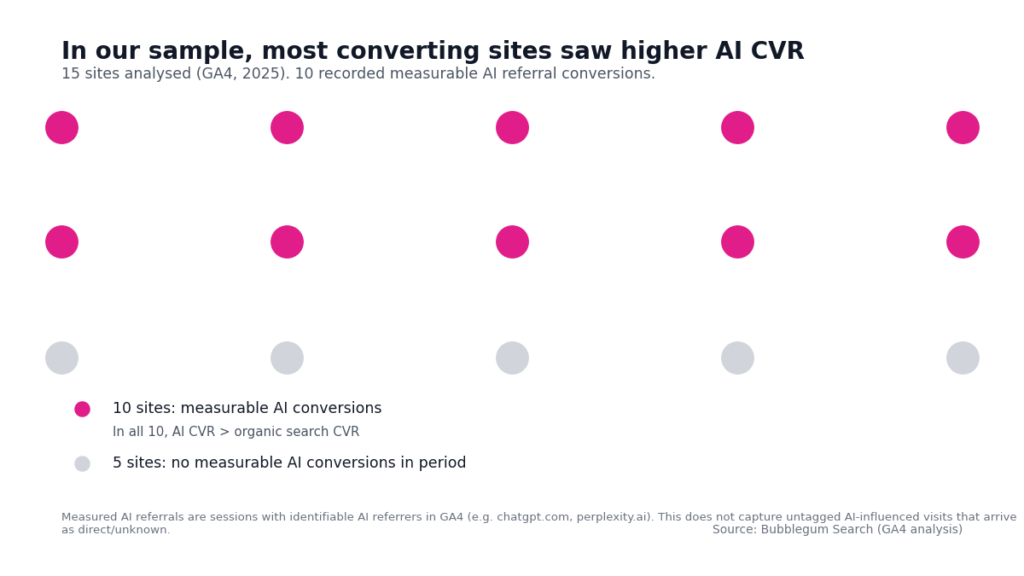
Out of 15 sites:
- 10/15 recorded at least one conversion from measurable AI traffic
- 10/10 of those had a higher conversion rate from AI referrals than organic search
- The uplift ranged from about ~1.2× to ~4.1×
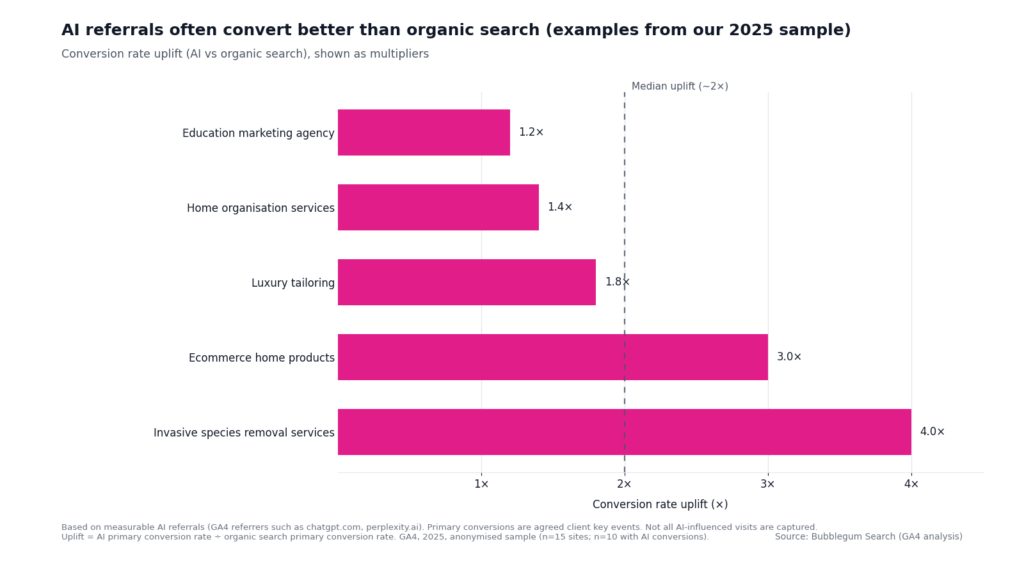
- The median uplift was ~2×
- Weighted across converting sites, AI converted at roughly ~2.7× the rate of organic search
“The interesting part isn’t just that AI seems to converts better in many cases, it’s that the gap can be material. For some sites it’s marginal, for others it’s multiples.”
Matt Cayless, Founder, Bubblegum Search
3) Most “no conversion” cases are simply low volume
In 4 of the 5 sites with 0 AI conversions, AI traffic was only 13 to 78 sessions for the whole period. That is not enough to draw conclusions.
There was one meaningful outlier where AI volume was higher but conversions were still zero. That becomes useful context rather than a problem. Where AI sessions land on research content, conversion can lag without a clear bridge to the key event.
What AI traffic is doing differently
AI often sends users to “the one page that answers the question”
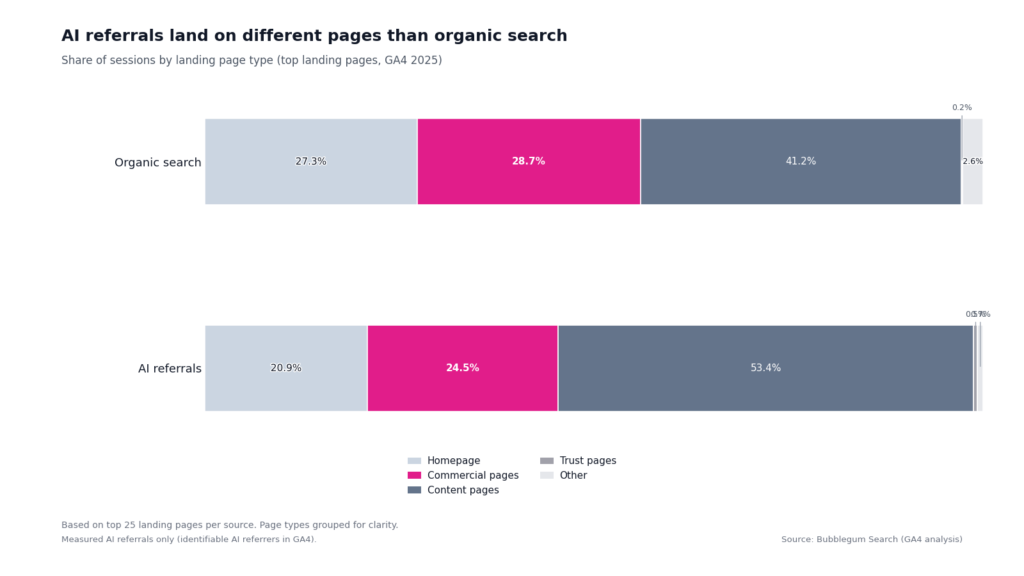
When we looked at the top 25 AI referral landing pages, we saw a recurring behaviour: AI traffic often concentrates on fewer, more specific URLs than organic search.
In one industrial B2B example, measurable AI referrals overwhelmingly landed on a single research-led article about manufacturing downtime costs. That page has also benefited from Digital PR activity, which likely helped it become the “reference” URL AI tools prefer to recommend.
“AI traffic behaves less like browsing and more like being handed a short list. That means your ‘best answer’ pages can suddenly matter a lot more than you think.”
Can Olken, SEO Account Manager, Bubblegum Search
AI can “pre-qualify” the click
Organic search often brings broad exploration. AI traffic can arrive after a longer research loop, with the user landing on a page that matches their question more precisely. That’s a good setup for conversion if the landing page makes the next step obvious.
What this looks like in the real world
Here are a few patterns from the sample:
- Invasive species removal (services): AI referrals converted at roughly 4× the organic search rate. This is a classic “high urgency, high intent” category where AI answers can push people towards direct action quickly when the page is clear and trustworthy.
- Home organisation (services): AI referrals converted at roughly ~1.4× organic search. AI entry pages skewed towards the homepage and training/course pages, which suggests users arriving after seeking a recommended provider or solution.
- Education marketing (agency): AI referrals converted slightly higher than organic search (around ~1.2×). AI traffic was drawn to stats and strategy pages, which makes sense for research-heavy decision makers.
- Luxury tailoring (services): AI referrals converted around ~1.8× organic search, with AI traffic landing on key commercial pages (home, tuxedos, suits). This is a good example of AI sending users straight to “buying pages”, not just blogs.
- Ecommerce (home products): AI referrals converted around ~3× organic search. AI entry pages included product and collection pages, which is exactly where you want AI-driven discovery landing.
What to track in GA4
You do not need complicated attribution models to get started. Track three things consistently:
1) AI traffic sessions
In Traffic acquisition, segment by Session source / medium and isolate referrers like:
- chatgpt.com / referral
- perplexity.ai / referral
- claude.ai / referral
- gemini.google.com / referral
- copilot.microsoft.com / referral
2) Primary conversion rate
Use your agreed key event and calculate:
Primary CVR = preferred conversions ÷ sessions
This avoids confusion caused by extra key events like downloads.
3) AI landing pages vs organic landing pages
Pull the top 25 landing pages for:
- AI traffic (filtered to those sources)
- Organic search (your baseline)
Then compare which page types win. The goal is not a perfect report, it’s to see whether AI sends people into blogs, comparisons, category pages, pricing pages, or service pages.
“If AI traffic is converting better, your job is to find where it lands and make the next step frictionless. Most sites haven’t done that yet.”
Matt Cayless, Founder, Bubblegum Search
What to change to win more AI-driven conversions
If AI traffic is converting better for many sites, the biggest unlock is simple: make the pages AI sends people to convert properly.
A practical checklist:
- Add a clear next step above the fold on your AI-heavy entry pages (one CTA, not five).
- Make the page “quote-ready” and “decision-ready”. Short definitions, steps, constraints, and proof.
- Strengthen trust signals on informational pages (who wrote it, why it’s credible, what happens next).
- Build conversion bridges from deep content. If AI lands users on a guide, give them a clean path to the key event without forcing a menu hunt.
- Double down on pages that AI already prefers. If one URL is becoming a reference point, improve it, expand it, and support it with PR and internal links.
Caveats
- This reflects measurable AI referrals, not all “AI-influenced” discovery.
- AI traffic is still small for most sites, therefore some properties will show zero conversions simply due to sample size.
- Industry and conversion type matter. Research-heavy B2B cycles may convert later, or via a different key event.
Closing
AI traffic might look like a niche channel today, but the conversion behaviour suggests it is worth treating seriously. If you track it cleanly and optimise the pages AI tools already send users to, you can turn a small slice of sessions into a disproportionately valuable slice of leads and revenue.
If you want a practical plan tailored to your site, Bubblegum Search’s AI SEO approach focuses on measurable visibility gains, citable content upgrades, and authority-led digital PR.