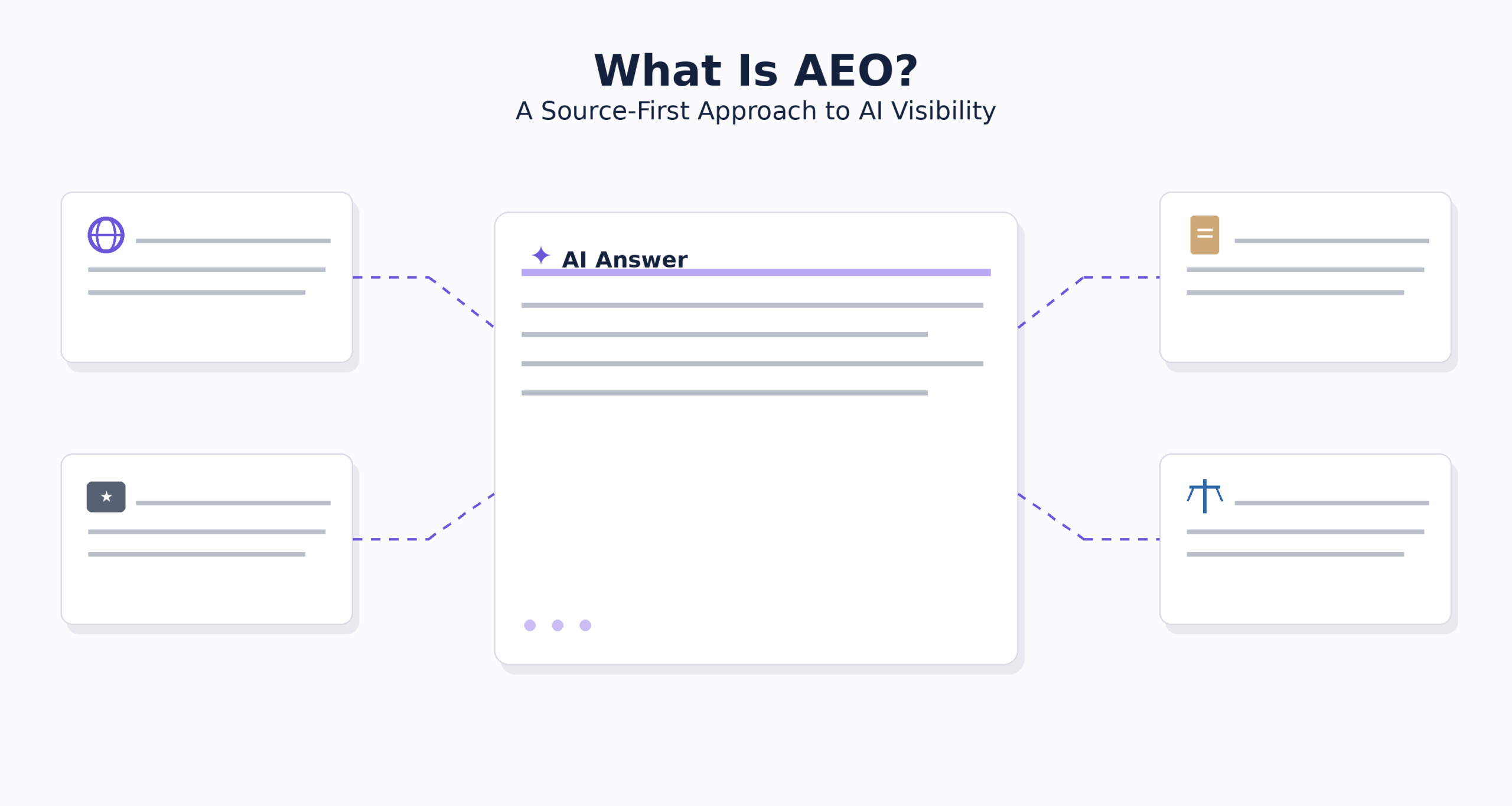

Back in the day, appearing high up in the classic 10 blue links of Google was the gold standard of online visibility, but those times are gone.
Nowadays, your potential customers might ask ChatGPT which provider they should choose, use Perplexity to compare several companies or rely on a Google AI Overview before visiting a single website.
Your business could rank well in traditional search and still be missing completely from answers on these new platforms (or described completely incorrectly).
This is where the new buzzword of organic marketing comes in – AEO (Answer Engine Optimisation).
AEO, in simple terms, is the process of improving how frequently, prominently and favourably a brand or business appears within AI-generated answers.
But importantly, AEO is not just about on-site changes.
AI platforms can draw on a much wider information pool around a brand, including publisher articles, comparison pages, reviews, directories, forums, videos and all kinds of other independent sources.
So – despite being an SEO staple of old – this means AEO should not start with another blog post , decided by keywords and search volume.
Instead, the process should start with gaining an understanding of:
- Which commercially important questions customers are asking
- Which brands currently appear in the answers
- How those brands are being described
- Which sources are influencing the responses
- Why competitors are being selected instead
- What information, authority, reputation or third-party recognition is missing
Like most good processes, you need a ‘lay of the land’ before you can get down to business, and so this is where you should start.
What is Answer Engine Optimisation?
Answer Engine Optimisation is the process of improving how a brand is understood, represented and recommended within direct and AI-generated answers.
Answer engines are LLMs, platforms and search experiences such as:
- ChatGPT
- Google AI Overviews
- Perplexity
- Gemini
- Microsoft Copilot
- Featured snippets
- Voice assistants
One crucial point to make early is that AEO overlaps heavily with SEO (and don’t let anyone tell you differently).
The classic SEO basics such as strong technical foundations, useful content and website authority still matter. And this makes complete sense, because AI platforms need to discover and understand reliable information before they can use it.
But where they start to differ is that AEO looks beyond whether a page ranks well (the gold standard for SEO).
It asks:
- Does the brand appear in the answer?
- Is it being recommended or merely mentioned?
- How is it positioned against competitors?
- Is it associated with the right services and expertise?
- Which sources are shaping how the platform understands it?
- Is the overall representation positive, neutral or negative?
The goal is no longer only to win a click.
It is now also to make sure your brand becomes part of the customer’s thought process before that click even happens. At Bubblegum Search, we call this “Brand Reputation Building”.
Why most AEO advice starts in the wrong place
A lot of AEO advice focuses on content formatting.
Businesses are told to add question-based headings, write shorter paragraphs, include schema and create more FAQs.
And true, none of that is necessarily wrong.
The issue though is that it starts way too late.
Before editing a page, you need to understand WHY the brand is missing from answers in the first place.
Ask yourself questions like:
Is the website failing to answer the basics of the question?
Does the information exist but is unclear or unvalidated?
Are competitors appearing because they are included in influential comparison articles and listicles?
Are reviews or community discussions playing a part in the brand’s reputation?
Do third-party sources repeatedly associate competitors with a service but barely mention your company?
Without knowing the answers to these questions, businesses risk just creating more content for the sake of it without addressing the actual visibility gap they have vs. their competition.
AEO should always begin with this wider understanding of the visibility gap, not just with the content editor.
Your website is only part of the answer
As any savvy marketer will know, a company saying something about itself is not the same as reviewers and customers raving about them.
Your website most likely has statements along the lines of ‘experienced’, ‘trusted’ or ‘one of the best providers in your market’, but an answer engine won’t just take this at face value.
They will also look at:
- Industry articles
- Comparison and recommendation pages
- Customer reviews
- Relevant directories
- Review platforms
- Forum discussions
- Community recommendations
- Expert commentary
- Partner websites
- Research and case studies
- Linked and unlinked brand mentions
These sources can help establish:
- What the business does
- What it is known for
- Which customers or sectors it serves
- Whether it has credible experience
- How it compares with alternatives
- Whether its reputation is positive or negative
And this is exactly why some AI visibility gaps cannot be fixed through editing pages on your website alone.
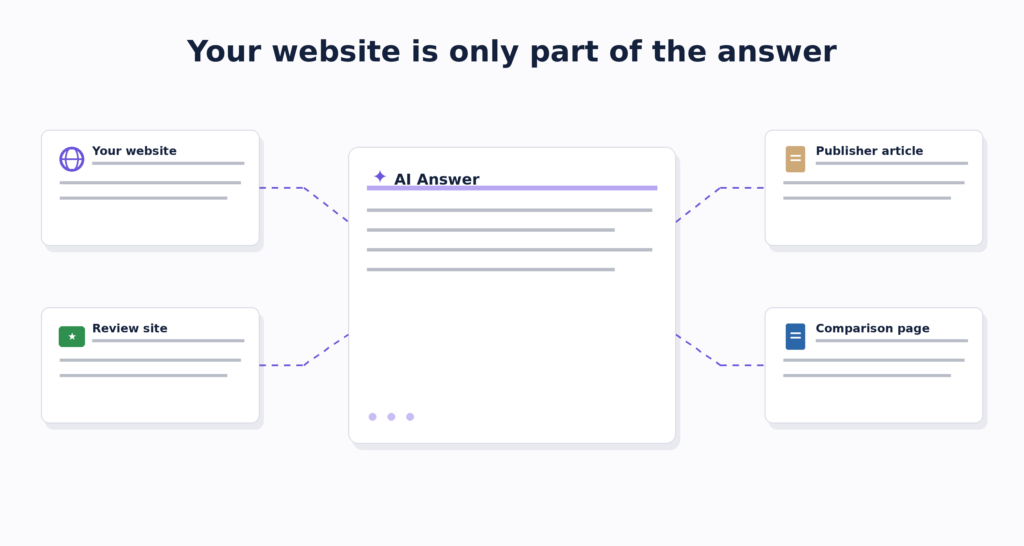
If the answers are being influenced by third party sources, your brand needs to become part of those sources and those conversations.
A source-first approach to AEO
We’ve been doing a LOT of research at Bubblegum Search, and we think an effective AEO process can be broken down into five stages:
1. Identify the prompts that matter commercially
We all love some keyword research, and it does remain useful, but people do interact differently with AI platforms.
For example, someone might search Google for:
AI SEO agency
But ask ChatGPT (likely with more spelling errors):
Which UK agencies can help my business appear more often in ChatGPT and Google AI Overviews?
They might then ask in the same conversation:
Which of those agencies also provides Digital PR or brand mention outreach?
Useful AEO prompt tracking should reflect the questions customers ask while:
- Researching a problem
- Comparing possible solutions
- Evaluating providers
- Checking credibility
- Deciding who to contact
The objective is not to track every possible prompt.
Tracking hundreds of broad questions can produce an impressive dashboard while revealing very little about commercial performance.
A smaller set of well-chosen prompts is often more useful when those prompts relate directly to valuable services and real buying decisions.
A prompt does not need thousands of searches to matter.
It needs the potential to influence the right customer.
At Bubblegum Search, prompt tracking starts with closely matched commercial prompts and longer, conversational questions that reflect how real audiences use AI search. The wording may vary, but each prompt is built around a clear underlying meaning, topic and intent.
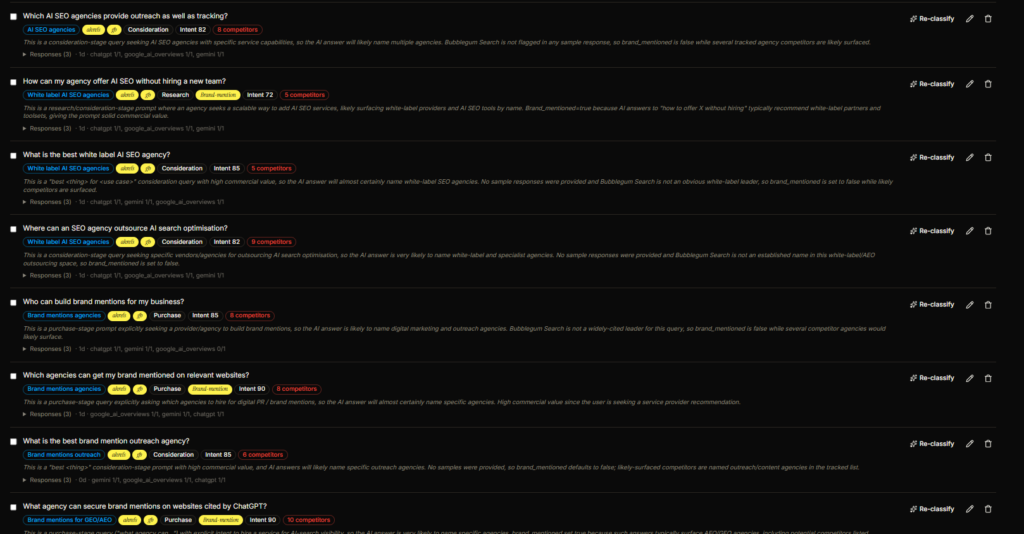
Our software then goes beyond simply recording whether a brand appears. It uncovers which competitors are being recommended, how frequently they appear and where your brand is being overlooked.
Each prompt is also grouped into a wider topic, allowing us to analyse performance across related questions rather than treating every prompt as an isolated result.
This gives us a much deeper view of what is influencing AI visibility.
We can identify the third-party websites and pages repeatedly shaping responses across each topic, then prioritise the sources most likely to influence multiple related prompts.
By focusing outreach on the strongest sources of influence within the most commercially valuable topics, we can target the brand mentions most likely to produce the greatest improvement in overall AI visibility and commercial impact.
2. Analyse the answers
Once the prompts are in place, the next step is to see what the platforms are actually saying about you. And there is more to this than a simple yes or no answer.
A useful review looks at four things:
• Presence and prominence: whether your brand appears, how often it appears and where it sits within the answer.
• Positioning: whether you are actively recommended, mentioned in passing or associated with the wrong service entirely.
• Reputation: how the platform describes the business and whether the overall tone is positive, neutral or negative.
• Sources and consistency: which pages are cited and how the answer changes across platforms, prompt variations and time.
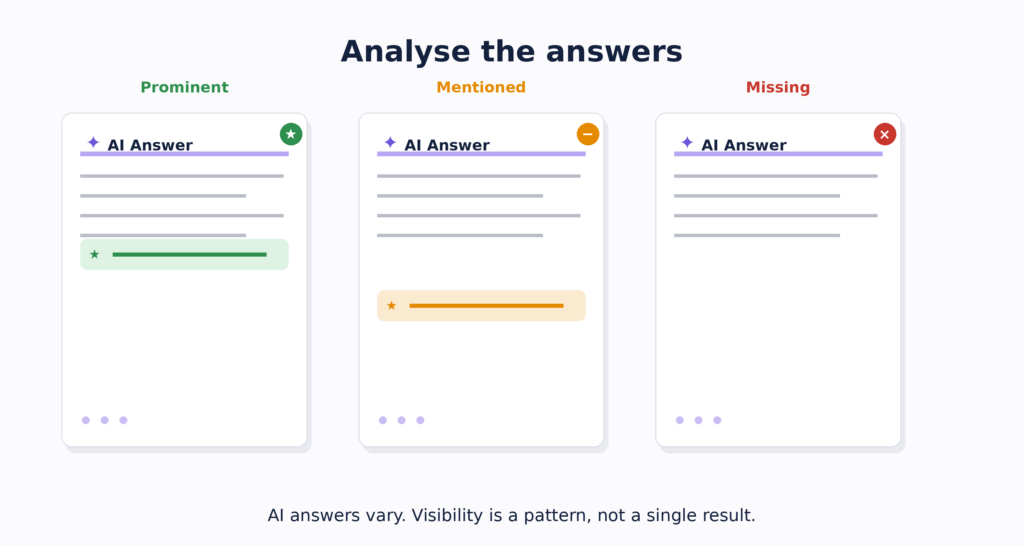
This is one of the big differences between traditional rankings and AI visibility. A Google position can move, of course, but you still have a fairly clear result to work with. AI answers are much less fixed.
The wording of the prompt matters. The platform matters. The time you ask can matter too. Even two very similar questions can produce a different mix of brands, descriptions and sources.
So, one lucky mention does not tell you much. What matters is the wider pattern across a group of commercially relevant prompts. A competitor being recommended again and again is far more significant than your brand appearing once, halfway down an answer.
Mention volume only tells part of the story as well. You might appear fairly often but still sit below competitors, be described vaguely or be linked with the wrong service. In other words, “we were mentioned” is not enough. Visibility, prominence and reputation need to be looked at together.
Bubblegum Search Intelligence brings these signals into one place, allowing us to compare brand presence, competitor visibility and answer positioning across related prompts rather than relying on a handful of manual searches.
Book a demo to see how your brand currently appears across the prompts that matter to your customers.
3. Find the sources influencing the answers
This is the point where AEO becomes much more useful than simply checking whether your brand appeared.
When a platform shows citations, you can inspect the sources directly. When citations are less obvious, repeated patterns can still tell you a lot about the information shaping the response. Comparison articles, publisher guides, directories, review platforms, forums, case studies, research and video transcripts can all play a part.
The key question is not simply, “Which websites have the most authority?” It is, “Which sources are influencing the prompts that matter to this business?”
A huge national publication might have plenty of authority but no real connection to the questions your customers are asking. A smaller specialist site could be much more valuable if it keeps appearing across a commercially important group of prompts.
Source analysis often exposes the reason behind a competitor’s advantage. For example:
• A competitor may appear repeatedly because it is included in several comparison articles.
• A publisher may cover your category in detail but omit your brand entirely.
• A review platform or old external page may be doing most of the work in shaping how providers are compared.
You may even find your own website being cited without the company itself being recommended. That is useful intelligence too, because it shows that the content is being trusted while the wider brand association still needs work.
This is why we favour a source-first approach. Instead of producing content based only on keyword volume, we look at the information already shaping the answer and work backwards from there.
Bubblegum Search Intelligence groups sources around the topics and prompts they influence. That helps us spot the pages with the widest potential impact, rather than treating every citation as an isolated win.
4. Diagnose and prioritise the gaps
By this stage, you should have a much clearer view of why your brand is being overlooked. The next job is to put a name to the gap, because different problems need different fixes.
| Gap | What it looks like |
| Content | The website does not properly answer the question. |
| Clarity | The information exists, but it is vague, buried or difficult to pull out. |
| Evidence | The brand makes strong claims without enough proof behind them. |
| Authority | Competitors have built stronger recognition around the subject. |
| Brand mentions | Influential third-party sources discuss competitors but leave you out. |
| Reputation | Reviews or external conversations are reducing confidence. |
| Association | The brand is not consistently linked with the service or expertise it wants to be known for. |
A missing article cannot always be solved through outreach. A lack of independent recognition will not disappear because you publish more claims on your own website. And no amount of schema will fix a reputation problem.
Once the gap is clear, the opportunities need to be prioritised. We normally weigh up the commercial value of the prompt, how often a source influences related answers, whether competitors already appear there and whether the opportunity is genuinely realistic.
This is where AI visibility data stops being an interesting dashboard and starts becoming a useful action plan. Not every gap deserves the same amount of time, and not every source is worth chasing. The aim is to find the changes most likely to improve visibility across the topics that matter commercially.
5. Improve the information environment
Once the gaps have been diagnosed and prioritised, the actual work can begin. The right response depends entirely on what the data has uncovered.
Sometimes the job is on-site: improving a service page, creating a genuinely useful guide, adding clearer proof or publishing original research. In other cases, the issue sits outside the website and calls for stronger reviews, corrected external information, expert commentary or inclusion in relevant comparisons.
The format is not the strategy.
It should not be chosen because someone on LinkedIn has declared that AI platforms love FAQs, lists or 40-word paragraphs. Those formats may be useful, but only when they solve the actual visibility gap. The real question is what information, authority or reputation problem needs to be closed.
Targeted brand mention building
For plenty of commercially important prompts, improving your own website will only get you so far. If the answers repeatedly draw from publisher articles, comparison pages, reviews or community discussions, your brand needs to become part of that wider information pool.
This is where targeted brand mention outreach comes in. It can involve Digital PR, expert contributions, relevant publisher outreach, independent reviews, credible directory profiles, partnerships and both linked and unlinked mentions.
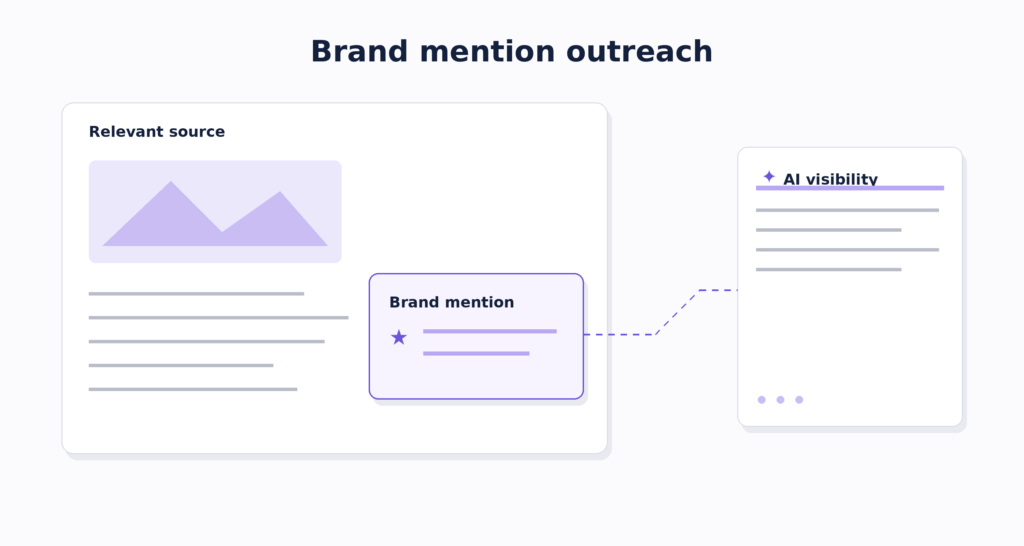
This is not just traditional link building with a shiny new name. A backlink can be useful for SEO while having very little connection to the sources influencing AI recommendations. On the other hand, a relevant mention in a trusted comparison or specialist article may be valuable even when the link itself is not the main prize.
A useful mention does three jobs at once: it appears in a relevant and credible source, connects the brand with the right service or expertise, and supports the wider reputation the business is trying to build. Context and association matter far more than raw volume.
Our outreach is informed by the same source data used in the intelligence stage. That means we can focus on the publishers and pages already influencing the target topics, rather than building mentions blindly and hoping something sticks.
Book a demo to see how AI Search Intelligence and brand mention outreach work together.
A practical example
Imagine a garden room company is missing from AI prompts asking for the best garden room companies in Surrey. Its website is already in decent shape, with detailed service pages, strong project examples and clear information about the areas it covers.
The obvious SEO response might be to publish another page targeting “best garden room company Surrey”. But the source data tells a different story.
The companies being recommended all appear in the same three comparison articles, a specialist home improvement directory and several highly visible review pages. The website is not the main problem. Independent recognition is.
A more useful plan would therefore combine outreach to the relevant publishers, a stronger customer review process, improved specialist directory profiles and useful expert input for the publications already shaping the answers. The original prompts would then continue to be tracked to see whether the pattern changes.
Without doing the answer and source analysis first, the company could spend months producing more content and still fail to address the reason competitors keep being selected.
Tracking is not the strategy
Knowing that your brand appears in 18% of tracked answers is useful. It gives you a benchmark and something to measure over time. But the percentage itself does not improve anything.
The real value lies in understanding which missing prompts matter commercially, why competitors are appearing instead and which sources are giving them that advantage. From there, you can decide whether the answer is better content, stronger evidence, improved reviews, targeted brand mentions or a combination of several things.
AI visibility intelligence should not end with a monthly graph and a few coloured percentages. Tracking tells you what is happening. The useful bit is working out why it is happening and what you can do about it.
That link between intelligence and action is the whole point of our approach: the software finds the gaps and sources, then the content and outreach work is prioritised around what the data is actually showing.
AEO is about influence, not control
No agency can guarantee that a particular brand will appear in a particular AI-generated answer. Anyone promising otherwise is getting ahead of themselves.
Platforms, models and sources change. Answers can vary between users, prompts and even repeated searches. What AEO can do is improve the information and signals those platforms have available when they build an answer.
In practice, that means identifying the prompts influencing customer decisions, understanding which brands appear and why, finding the sources shaping the responses, and then improving both the information you control and the independent recognition you earn.
The brands that perform best in answer-led search will not necessarily be the ones publishing the most content. They are more likely to be the brands that explain themselves clearly, back up what they say and are consistently recognised in the places answer engines already rely on.
The process is fairly simple to understand: find the right prompts, analyse the answers, uncover the sources, diagnose the gaps and take the right action. Doing it well is where the work comes in.
See what is shaping your brand’s AI visibility
Bubblegum Search Intelligence shows you more than whether your brand was mentioned. It brings together the prompts where you appear or are missing, the competitors being recommended instead, how your business is being described and the third-party sources influencing those answers.
We then use that intelligence to prioritise the on-site improvements and targeted brand mention outreach most likely to make a difference.